There is no nonstop flight from the United States or Canada to the Maldives, from any airport. Every trip is at least one stop, and from most of North America the journey is closer to a full day than half of one. That makes the usual question, which airline, less useful than two others: which hub suits your home airport, and what time of day that routing puts you on the ground in Malé. The second one decides whether you reach your island the day you land.
What follows is the practical version: realistic journey times from the main gateways, why a slower itinerary is often the better one, what flights really cost and when, the entry rules, and how the trip fits around American holidays. Canada gets its own section at the end.
There's no nonstop: pick your hub by your home airport
From the East Coast, the quickest options are daytime departures on Emirates via Dubai or Qatar Airways via Doha. In a January 2027 sample from New York, both took just over 18 hours, and Washington Dulles was similar. From Boston and Miami, the best one-stops ran about 20 to 23 hours. From the central and southern gateways, allow roughly 22 to 24 hours: Qatar from Dallas was the stand-out at just under 22 hours, while Houston, Chicago and Atlanta mostly came in between 23 and 24. Atlanta has also had an Etihad nonstop to Abu Dhabi since July 2025.
From the West Coast, the fastest one-stops from Los Angeles and San Francisco run about 22 hours, and good everyday itineraries about 23½ to 24. The best of them in our sample went west via Europe, not across the Pacific: Turkish Airlines via Istanbul and SWISS or Edelweiss via Zurich. Turkish turned up from every US gateway we checked, and it is often the cheapest one-stop. European hubs are also a steady alternative to the Gulf: BA and Virgin via London, Condor via Frankfurt. Some Emirates itineraries switch to flydubai for the Dubai–Malé leg, so check who operates each flight. And since 2026's regional conflict disrupted the Gulf carriers for weeks, check current airline and government advice for any Gulf routing before you book.
Land in the morning, not at 3 p.m.
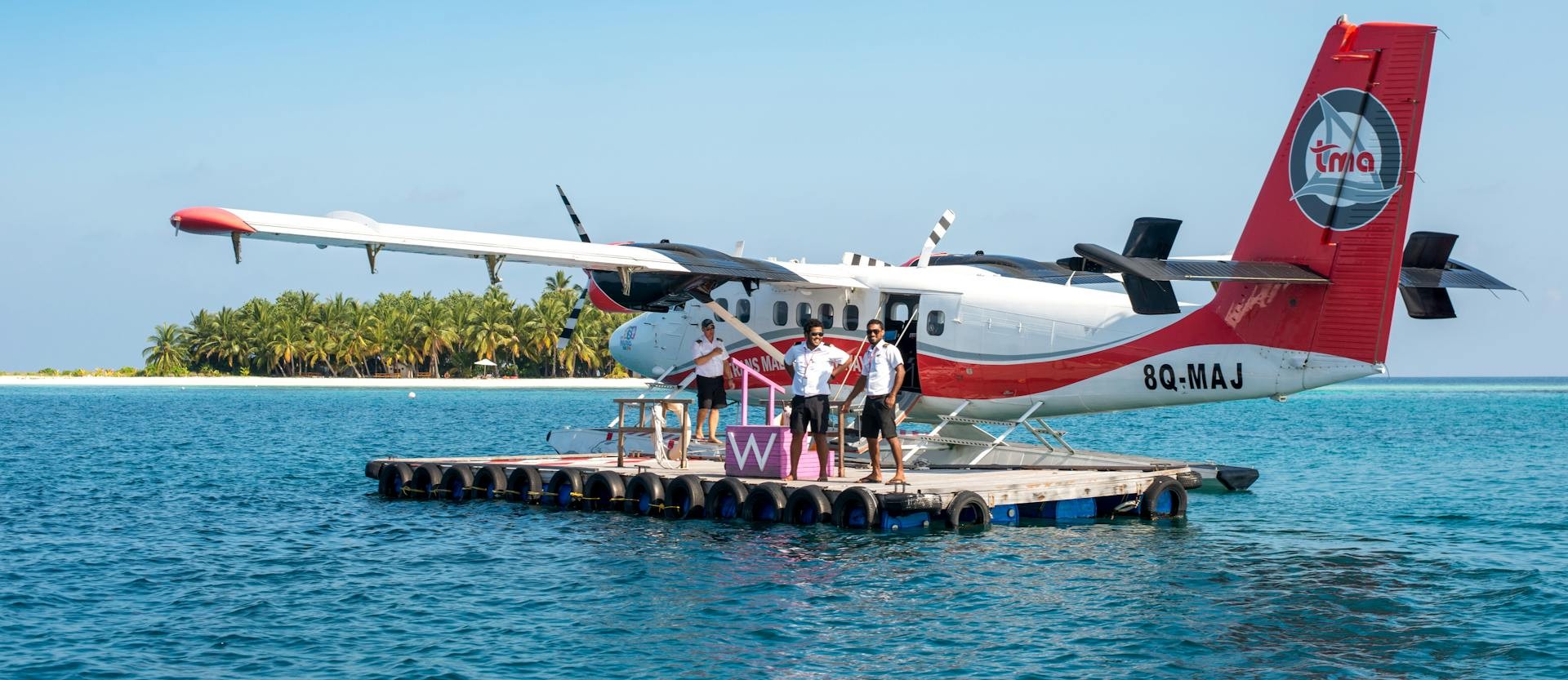
Seaplanes to the outer atolls fly in daylight only, and resorts generally need your international flight to land by around 3 p.m. to make the same-day transfer (your resort confirms its own cut-off). Most one-stop itineraries from the US arrive in Malé between about 5 a.m. and 8:15 a.m.: Turkish lands at 07:25, Qatar's evening departures at 07:50. That fits the seaplane window with hours to spare.
The fastest East Coast options are the exception. Those 18-hour daytime itineraries land at about 14:50 or 14:55, right at the cut-off, so a modest delay means a night in Malé or Hulhumalé instead of your villa. Some Canadian and two-stop routings land late at night and guarantee an overnight. For a seaplane resort, the slower overnight itinerary is often the better choice, because it gets you to the island the same morning. Resorts reached by speedboat from the airport can take a later arrival.
From North America, the fastest itinerary to Malé is not always the fastest way to your island.
What flights really cost, and when they're cheapest
Round-trip economy from most US gateways typically runs about $1,000–$1,600 in the cheaper months and $1,500–$2,250 in June and July. Business-class round trips start around $4,000–$6,000 (Google Flights, September 2026; fares move quickly). The "$800 round trip" figure still quoted on many pages is one-way territory now. The cheapest genuine round trip we found was $980 from New York, on a 31-hour Gulf Air routing.
The timing surprises people. January was the cheapest month to fly from New York, Chicago, Los Angeles, Seattle and Atlanta, and April from Washington, San Francisco, Houston, Dallas, Miami and Boston. June and July were the most expensive from every gateway, even though that is the Maldives' low season for resort rates. So for Americans, cheap flights and cheap resorts rarely fall in the same month. The Maldives' US$50 departure tax is already included in the fare.
Passport, visa and the one form you need
US and Canadian passport holders get a free 30-day visa on arrival, so there is nothing to apply for or buy. The paid "Maldives visa" services that advertise against that search are selling something the government gives away. You'll need a return or onward ticket, a confirmed booking at a registered resort, hotel or guesthouse, and enough funds for the stay. The Maldives' legal minimum is one month of passport validity. Canada's government advises six months from entry, and six is the safe number to carry with airlines too.
The one form you do need is the free IMUGA Traveller Declaration, submitted on the official immigration portal in the 96 hours before you land, one per traveller, children included. If you want to break the trip in Istanbul, US and Canadian citizens have been able to visit Türkiye without a visa for up to 90 days since late 2023. Canada's advisory for the Maldives is to exercise a high degree of caution because of terrorism risk, and the US rates it Level 2, exercise increased caution, while noting that crime on the resort islands is rare.
Dollars and tipping: what's different from home
For Americans, the currency is the easy part: resorts price and bill in US dollars. The costs that surprise first-timers are the ones outside the room rate. The green tax is US$12 per person per night at resorts, which comes to $168 for a couple over a week. A mandatory service charge and a government tax are added to resort bills. And the transfer, particularly a seaplane, is usually priced per person on top of the villa. Canadians will see every figure through the exchange rate: at about C$1.41 to the US dollar in September 2026, a $10,000 trip is roughly C$14,100.
Tipping works differently from home. Since 2021, Maldivian law has required tourism businesses to add a service charge to bills, and it is shared among the staff, so the American reflex of adding a tip to every meal doesn't apply. Extra tips are optional. A couple of dollars a day for your room attendant is common, with a little more for dive guides or boat crew who looked after you well. US dollar cash, given directly, is the norm.
Fitting it around Thanksgiving, the holidays and spring break
The Maldives' dry season runs roughly December to April, with February and March the driest months; May to November is wetter and cheaper. Thanksgiving (26 November 2026) falls in the good-value shoulder before the festive peak, but a four-day weekend is too short for a trip of 20-plus hours each way, so add vacation days or save it for another time. Christmas and New Year is the global peak, with the highest rates of the year and minimum stays.
Mid-January to February is the quiet winner. The long weekends around Martin Luther King Jr. Day (18 January 2027) and Presidents' Day (15 February) fall in the dry season, rates ease after the festive period, and January is the cheapest month to fly from several gateways. Spring break, which usually lands somewhere in March or April, gets the driest weather at peak prices, so book early. Summer brings the lowest resort rates and the dearest flights.
Jet lag, stay length and stopovers
The Maldives runs on UTC+5 with no daylight saving. In winter it is 10 hours ahead of New York and 13 ahead of Los Angeles; in summer, 9 and 12. Noon in Malé in December is 2 a.m. in New York. The CDC's guidance is that people adjust eastward by about an hour a day, so a big shift takes days. Combined with a 20-plus-hour journey each way, that is why seven to ten nights is the realistic minimum; five nights leaves little clear time once the travel days are counted.
A stopover can make the trip easier. Many cheaper Etihad and Qatar fares already come with layovers of eight to thirteen hours in Abu Dhabi or Doha. Turning that into a planned night or two breaks up the journey and resets your arrival to a morning landing. Several hub airlines sell stopover packages; check your carrier's current terms.
Canada, and what "all-inclusive" means here
From Toronto, the quickest itinerary in our sample took about 21½ hours but had two stops and landed at night; the best one-stop, Turkish via Istanbul, takes about 22½ to 25 hours and lands at 07:25 on most days. Qatar has flown Toronto–Doha nonstop since December 2024. From Vancouver, the best one-stop was about 23 hours, and Turkish via Istanbul again gave a clean morning arrival.
Canadians search for the Maldives "all-inclusive" more than almost anyone, which is the Caribbean habit talking. In the Maldives, all-inclusive is a meal-plan tier, and it varies by resort: which drinks are covered, which restaurants, and whether any excursions are included. It isn't the everything-on-the-wristband model of Cancún or Punta Cana, and the transfer is usually extra. Read the inclusions before comparing prices.
The routing from North America comes down to three choices: a hub that suits your airport, a morning landing if your island is a seaplane ride away, and enough nights to make the journey worthwhile. If you are coming from the Caribbean habit of all-inclusive, our guide to all-inclusive in the Maldives explains what each tier really covers and which resorts do it well.