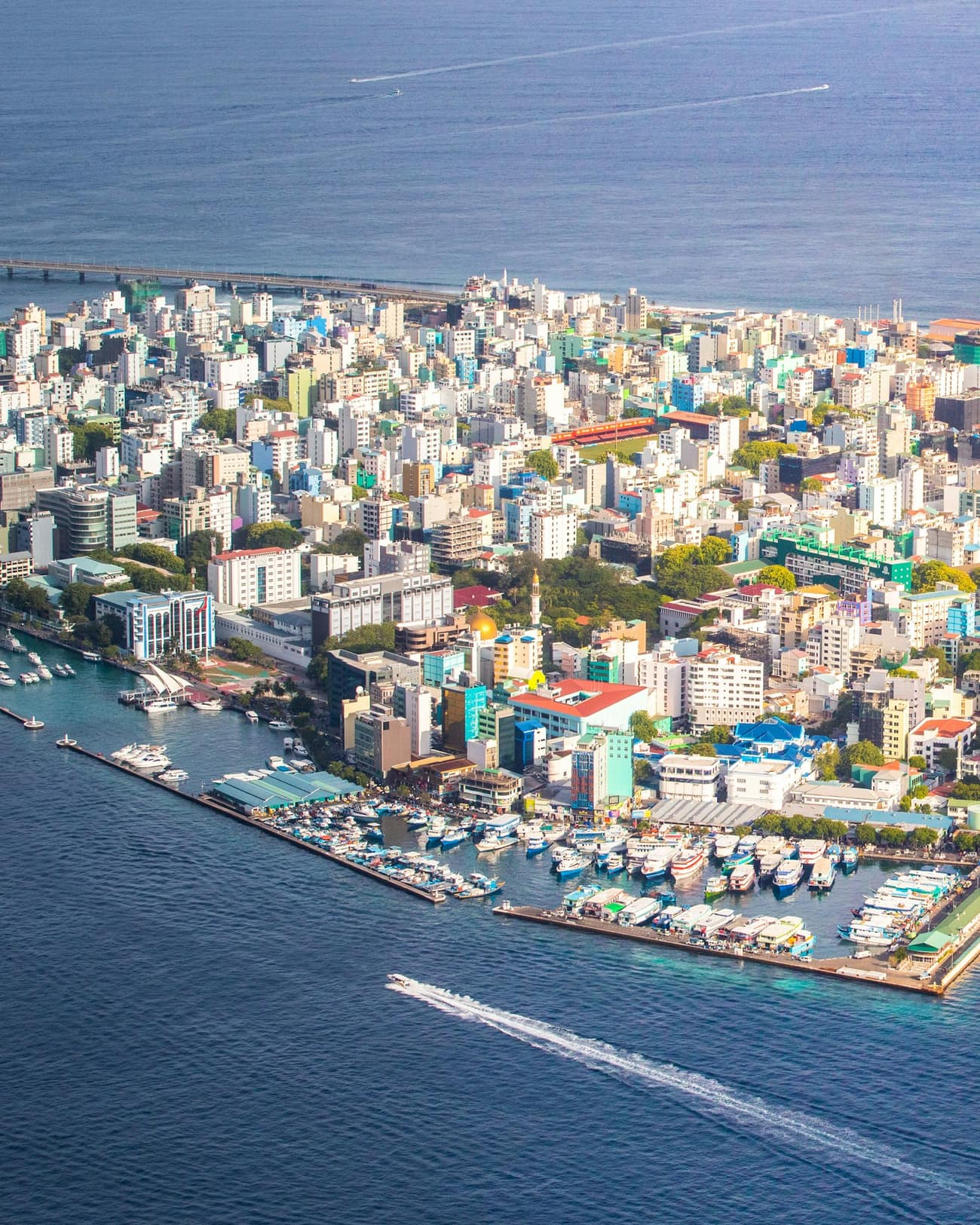
The Maldives is the flattest, lowest country on Earth: roughly 1,190 coral islands averaging about 1.5 metres above the sea, more than 80% of the land under a single metre, and a highest natural point of only around 2.4 metres. With seas rising three to four millimetres a year and the IPCC projecting up to a metre of rise by 2100, the popular shorthand writes itself — the Maldives is "sinking," and you'd better go before it's gone. A former president, Mohamed Nasheed, dramatised exactly that fear in 2009 by holding a cabinet meeting underwater in scuba gear. It made for an unforgettable photograph. It also told only half the story.
The science is stranger than the slogan
The honest, peer-reviewed picture is more nuanced — and the nuance is the real story. Coastal scientists led by Paul Kench have shown that atoll reef-islands are not static lumps waiting to drown; they are dynamic landforms, continually fed by sand that healthy coral reefs manufacture. Studied over decades, many islands have stayed stable or even grown in area despite rising seas — Tuvalu's land grew nearly 3% over forty years; one Maldivian atoll grew 2.4% over four decades. So "the Maldives is sinking beneath the waves" is, strictly, an oversimplification. The islands move, build and rebuild.
The islands aren't passively drowning. The accurate fear isn't that they vanish — it's that they become impossible to live on.
The real threat
That doesn't make the Maldives safe — it makes the danger more specific. The accurate framing is that the islands are becoming increasingly hard to live on, well before they disappear. A 2018 study identified the near-term killer: wave-driven flooding that salts the freshwater aquifers islands depend on and wrecks infrastructure, which could render many islands uninhabitable by mid-century. It's the basis for the figure you'll see everywhere — that roughly 80% of the Maldives could become uninhabitable by around 2050, a NASA- and USGS-cited headline that's really shorthand for this freshwater-and-flooding tipping point, not a date the land sinks. And the deeper, longer threat is coral bleaching — because if you kill the reef, you kill the sediment factory that lets the islands keep rebuilding themselves. The country is already adapting in concrete: the raised, reclaimed island of Hulhumalé sits twice as high as Malé, a Dutch-engineered floating city is taking shape in a lagoon near the capital, and a Japanese-funded seawall rings Malé itself.
What it means for a traveller
This reframes the Maldives from "go before it sinks" doom-tourism into something more honest. There is no single date on which the country disappears — the honest answer to "when will it sink" is a gradual loss of habitability, not a submersion deadline. The country is not on a fixed countdown to vanish; its islands are dynamic and, with healthy reefs, partly self-maintaining. What is genuinely at risk is the freshwater, the infrastructure and — critically for a visitor — the reefs themselves, which are both the sediment engine and the thing you came to snorkel. That makes reef-positive choices substantive rather than greenwashing: resorts with real coral-restoration programmes, marine biologists on staff and proper waste and water systems. The carbon irony deserves naming too — every Maldives trip is a fly-in trip, and aviation is a major driver of the very emissions threatening the place. The grown-up response isn't guilt or doom; it's longer stays over multiple short ones, and supporting the resorts genuinely doing the work.
Reef health is the linchpin — of the islands' future and of your trip. Our Maldives snorkeling guide rates the house reefs and flags the resorts running serious coral-conservation programmes.