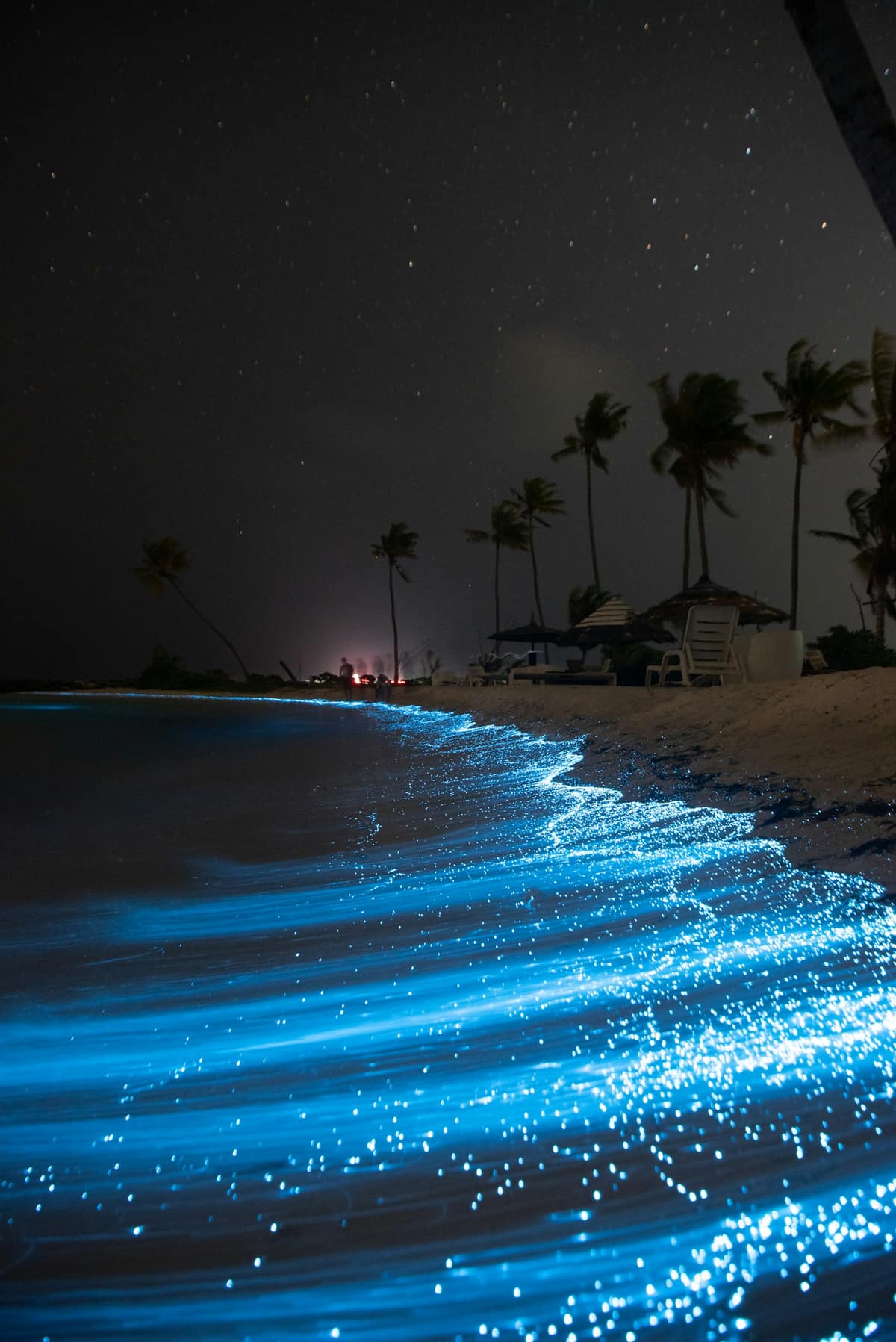
You have almost certainly seen the photograph: a dark Maldivian beach where every breaking wave and every footprint glows electric blue, as though someone had tipped the night sky into the shallows. It is captioned, nine times out of ten, "Sea of Stars, Vaadhoo Island," and it has been shared so many millions of times that it has become a genuine bucket-list line. Two questions are worth answering before you build a trip around it. Is it real? And can you actually plan to see it?
The honest answers are yes, and not really — and both are more interesting than the caption.
What is actually glowing
The light is alive. It comes from bioluminescent plankton — microscopic, single-celled organisms called dinoflagellates, the likeliest candidate here being the aptly named "sea sparkle" — that drift at the surface and fire off a brief flash of cold blue light when the water around them is physically disturbed. A wave folding over, a paddle dragged through the shallows, a foot pressed into wet sand: each is a tiny mechanical shock, and each trips a pinprick of light. Multiply that by the millions of cells in a rich bloom and a whole shoreline can appear to spark.
The chemistry is the same reaction that lights a firefly. A light-emitting molecule, luciferin, is switched on by an enzyme, luciferase, and oxidised to release its energy almost entirely as light rather than heat — which is why it is called "cold" light, glowing at around 475 nanometres, the precise blue that travels furthest through seawater. The whole cascade, from touch to flash, fires in roughly fifteen-thousandths of a second.
Why glow at all? The leading idea is the "burglar alarm." A flash set off by something grazing the plankton is thought to draw the attention of larger, hunting predators to the grazer — turning the attacker into prey, and so buying the single cell its life. Experiments have borne the effect out. There is something fitting about the most romantic sight in the Maldives being, at heart, an act of self-defence: the blue you see is a microscopic cell shouting for help.
The blue you see is, at heart, a microscopic cell shouting for help.
About that beach
Here the story gets slippery, and most accounts skip the interesting part. The viral images were taken by the photographer Will Ho and exploded online in January 2014 — but his original posts named no specific island, only "the Maldives." Later reporting traced his shots to a resort on Mudhdhoo, in Baa Atoll; the now-ubiquitous label "Vaadhoo, Raa Atoll" attached itself to the same frames afterward, helped along by travel sites and by the fact that there are at least three different Maldivian islands called Vaadhoo or Vadoo. The truth underneath the confusion is simpler and more useful than any single address: the glow belongs to no one beach. Blooms wash up across many Maldivian shores — in Raa, in Baa, in Lhaviyani — whenever the conditions align.
Which is liberating, because it frees you from hunting a single mythical island. If seeing the glow matters to you, the practical play is to base yourself in the plankton-rich northern and central atolls — Raa, Baa, Lhaviyani — each a short seaplane hop from Malé, and to choose a resort with a quiet, dark lagoon side away from the jetty floodlights, where a faint bloom actually stands a chance of showing.
The other thing the caption hides is the camera. The spectacular versions are almost always long exposures — a shutter held open for fifteen or thirty seconds on a tripod, pooling light the naked eye never sees all at once. What you actually witness standing on the sand is real but far softer: scattered pale-blue sparks, brightest where you disturb the water, dim enough that you need to let your eyes adjust to the dark before they register at all. Arrive expecting the postcard and you may feel cheated. Understand what you are looking at, and it is quietly extraordinary.
How to actually improve your odds
Because the display depends on a living bloom, it cannot be scheduled — but you can stack the odds, and the right frame of mind is closer to chasing the aurora than visiting an attraction. The short answer on timing: the window runs roughly June to November, and the nights around the new moon are best. Three things matter. Travel in the plankton-rich southwest-monsoon months, roughly June to November, when blooms run thickest. Pick the darkest nights you can, around the new moon, because even a half moon washes the faint glow out. And go late, walking the lagoon shallows well after dark and trailing a hand or a foot through the water, because the light answers movement — still water stays black.
The most valuable tip costs nothing: ask your resort's marine team on arrival whether anything is glowing. They watch the water nightly and will know if there is something to see that week. Treat the Sea of Stars as a lottery ticket that comes bundled with the holiday rather than the reason for it — and know that there is a reliable consolation prize. Many resorts run night snorkels on the house reef, where churning your fins through dark water sets off the same blue sparks on demand, in miniature, right around your body. It is the Sea of Stars at arm's length, and it almost never disappoints.
There is a final irony worth carrying to the beach. By daylight, a heavy bloom of the very same plankton can stain the water a murky rust-red — the so-called red tide. The clear ocean of the Maldives keeps those at bay better than most coasts do, but it is a useful reminder that the magic and the menace are the same organism, simply lit differently. Which is, in the end, a far better story than the caption ever tells.
Raa rewards the patient traveller by daylight too. Our Raa Atoll guide covers its new-generation luxury resorts, the quietest reefs in the country and how to time a visit to the northern atolls — where Vaadhoo itself sits.