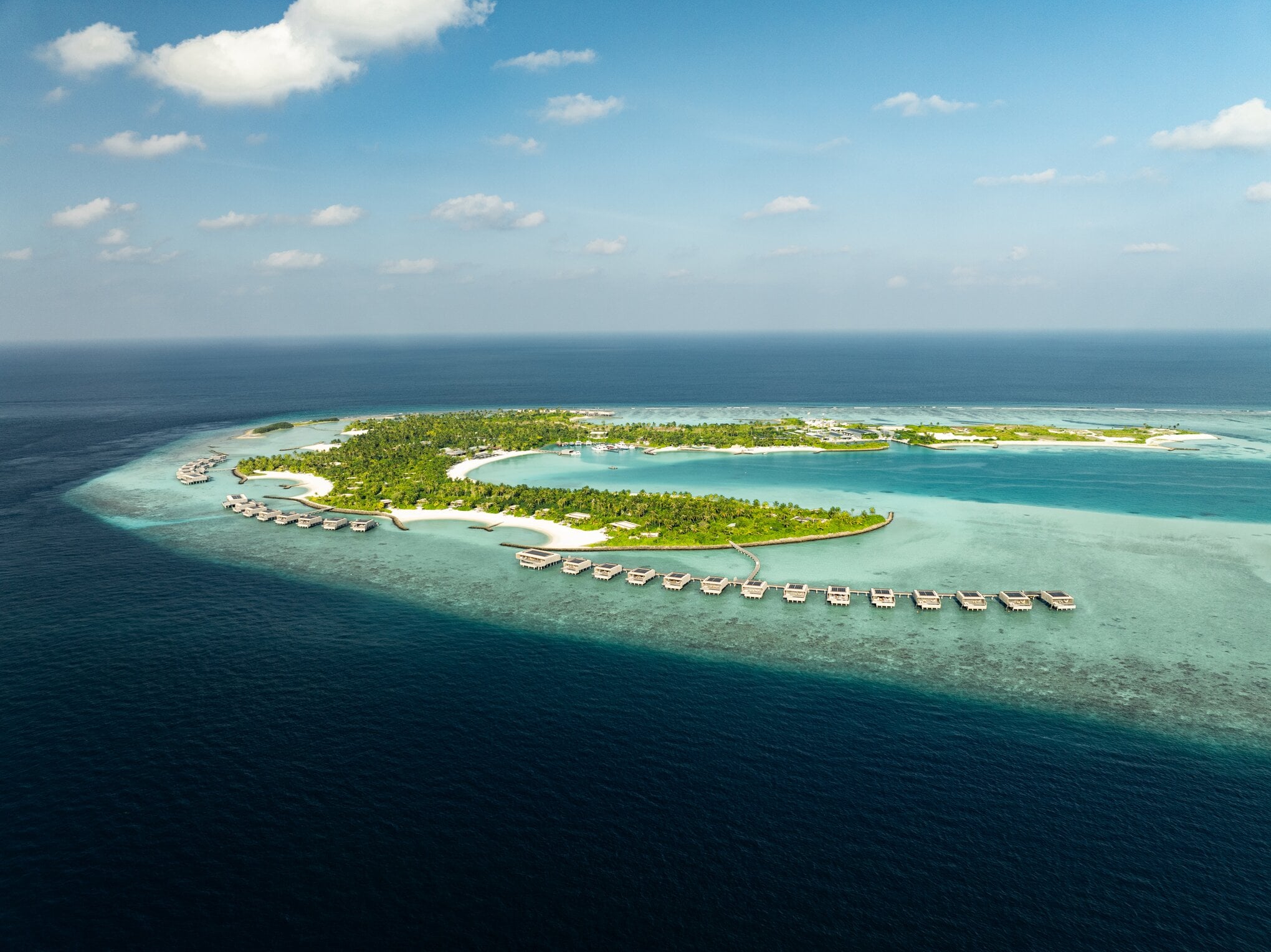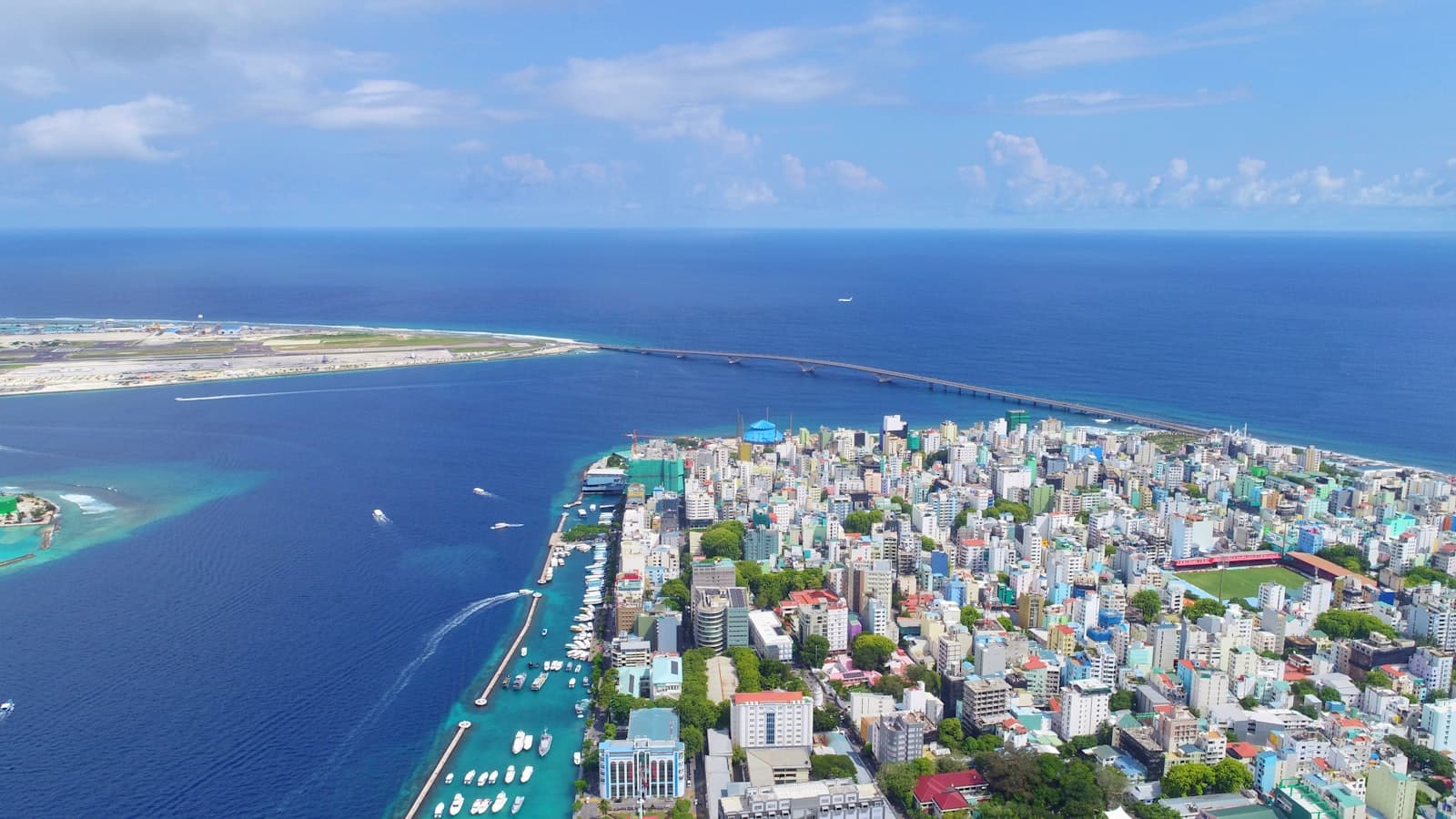
Here is the strangest fact about the Maldives: the one place nearly every visitor touches is the one place almost none of them see. Step off an international flight and you land on Hulhulé, the airport island — and within minutes you are funnelled onto a seaplane, a speedboat or a domestic flight to a resort, often without a second glance at the dense grey city shimmering across the water. That city is Malé, the capital, and it is the improbable urban heart of one of the most spread-out nations on the planet.
It is also one of the most crowded islands on Earth. Roughly 212,000 people — about two in five of all Maldivians — are packed onto a coral island whose dense core is under two square kilometres, at a population density that locally exceeds Manhattan's. You can walk across the old town in twenty minutes. In that small space sit a working tuna market, a gold-domed grand mosque, a seventeenth-century coral-stone mosque on UNESCO's tentative list, and a national museum housed in the old sultan's palace. There is no beach. This is the antithesis of the postcard Maldives — and that is exactly what makes it interesting.
A nation crammed onto a rock — so it built another one
Malé has nowhere to grow. So the state did something radical: it manufactured higher ground next door. Hulhumalé — "the City of Hope" — is an artificial island pumped up from the seabed to sit about two metres above the waves, roughly twice the height of low-lying Malé, explicitly as a defence against rising seas. Since 2018, the 1.4-kilometre, China-funded Sinamalé Bridge has fused Malé, the airport island and Hulhumalé into a single road-connected conurbation. The bridge quietly changed the maths of a visit: where a stop in the capital once meant a ferry, the fish market and the Grand Friday Mosque are now a ten-minute taxi from the arrivals hall.
Getting across is cheap and easy. The old public ferry still runs from the jetty beside the terminal — every fifteen minutes or so, a rufiyaa or two (about a dollar), cash only — and lands you a short walk from the fish market. An MTCC bus costs roughly the same. Or take a fixed-fare taxi over the bridge: about MVR 70 to Malé, a little more to Hulhumalé. None of it needs booking, and none of it dents a layover budget.
What there actually is to see
A proper wander takes a half-day. The signature landmark is the Islamic Centre, whose gold dome (opened 1984, big enough for five thousand worshippers) dominates the skyline. Two minutes from the tuna market stands the real treasure: Hukuru Miskiy, the Old Friday Mosque, built in 1658 from interlocking carved coral boulders and arguably the finest coral-stone building on Earth — a genuine cultural landmark hiding in plain sight. Add the National Museum in Sultan Park, Republic Square with its giant flagpole, and the late-afternoon spectacle of the fish market as the day's tuna is landed, and you have a compact loop through the lived, working Maldives that the resorts are built to let you forget. The loop is also where you eat like a local: the streets between the markets are thick with small cafés, and the harbour-side food court is the place to stop for a plate of hedhikaa — the fried short-eats Maldivians take with sweet tea.
The place everyone passes through, and almost nobody sees — a dense, devout working city with no beach at all.
Is it worth stopping?
Honestly, most resort-bound travellers are right to skip it: there is no beach, no swimming, and a half-day is a hot, crowded, culturally rich urban walk rather than a holiday. But it genuinely suits a few people — anyone with a long layover (a three-to-four-hour loop is easy now the bridge exists), the culture-curious who want the real Maldives rather than the manufactured version, and anyone facing a forced transit night before an early seaplane. That last case has an obvious answer: Hulhumalé. The reclaimed island has the swimmable beach the capital lacks — a calm artificial strip on its eastern side (dress as you would on any local island) — and a cluster of budget guesthouses minutes from the runway, making it the sensible base before a dawn transfer. Treat the capital itself as a devout Islamic city: cover shoulders and knees, especially near mosques (non-Muslim visitors need permission or set hours), and don't expect a drink — alcohol is confined to the resorts. Plan around the midday heat and Friday prayers, and time the walk for the late-afternoon tuna landings. And if your layover is short or you came for water and sand, don't force it: go straight to your transfer, or take a sandbank day trip instead.
Most visitors are in and out of Malé in an hour — our guide to getting to the Maldives covers the airport, the seaplane-versus-speedboat choice and how to handle a transit night.