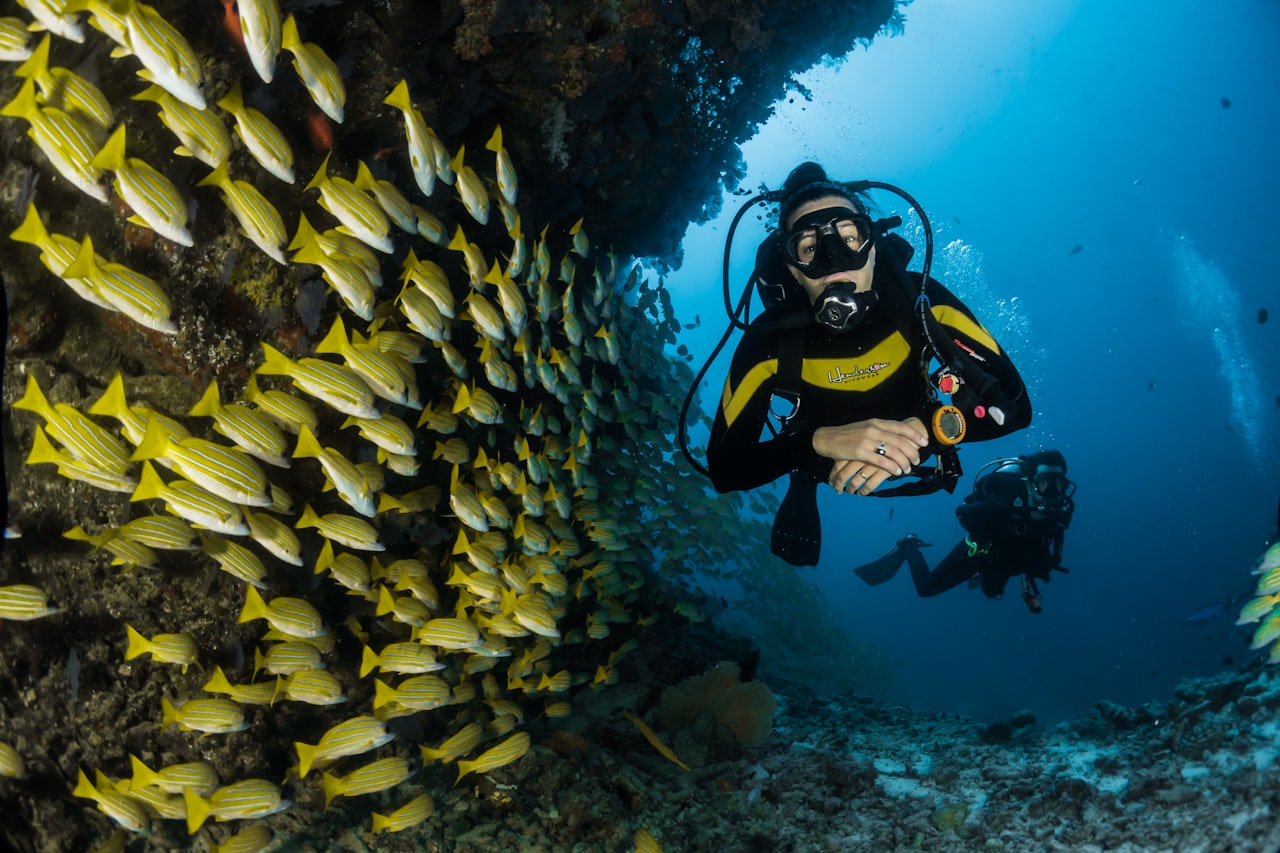
A Maldives liveaboard is a floating dive base. You sleep, eat and dive from one boat for a week — sometimes longer — logging three to four dives a day, roughly eighteen over the trip, while the vessel repositions overnight between atolls and sites that no fixed resort can reach. That mobility is the entire point. Instead of one house reef and a shuttle boat, you wake each morning on a different channel, coral pinnacle or wreck, and drop into a current-fed passage where grey reef sharks hang in the blue like a screensaver — what divers fondly call "shark TV."
The diving itself runs off a dhoni — a separate dive tender that carries the tanks, compressors and guides, so the mother vessel stays a quiet base while you step across for each dive. The rhythm is relentless in the best way: a dawn briefing over coffee, three or four dives spaced by roughly three-hour surface intervals, often a night dive, and the boat repositioning while you eat and sleep. Nitrox is usually included for certified divers, which is most of the point on a week of repetitive deep channel work.
The three routes
Most itineraries fall into three families. The classic "Best of" / Central Atolls loop works North and South Malé, Ari, Rasdhoo and Vaavu — Lankan's manta cleaning station, Fish Head (Mushimasmingili Thila), the white-tip swarm of a Maaya Thila night dive, South Ari's whale sharks, Hanifaru in season and the Alimatha nurse-shark night dive. The Deep South route runs Huvadhoo, Addu and, above all, Fuvahmulah — the apex-predator trip, headlined by the year-round tiger sharks of Tiger Harbour that have made Fuvahmulah a global bucket-list dive, plus the cave-riddled channel of Fotteyo Kandu, oceanic mantas, hammerheads and threshers. And the remote Far North offers the emptiest, least-dived reefs in the country.
When to go
The best window is the northeast "dry" monsoon, roughly December to April, with January to March delivering 25 to 40 metres of visibility and calm seas. There's a catch worth planning around: manta and whale-shark sightings flip from one side of an atoll to the other with the monsoon, so no single week catches everything. If Hanifaru's mantas are the dream, that's the opposite season — the southwest monsoon, June to November — and a different route. Pick your boat for the marine life you most want to see, not just the calendar.
A new atoll every morning, three dives a day, and the channels no resort guest will ever see.
Is it for you?
A liveaboard rewards the serious diver: more dives, better sites, and a lower effective cost per dive — roughly $50–80 against $60–100-plus at a resort — for somewhere between about $1,200 and $7,500 for seven nights depending on the boat, plus several hundred dollars in green tax, marine-park and fuel fees on top. But it asks something in return. These are drift dives in real current, so operators expect an Advanced Open Water certification, somewhere around 30 to 50 logged dives, comfort on a reef hook, and your own computer and surface marker. Dive insurance is mandatory. And it is unambiguously a dive trip — small cabins, simple living, the day organised entirely around the water. If you want an overwater villa and a spa, book a resort. If you want to dive the Maldives properly, there is no better way.
Not sure a liveaboard is the right call? Our Maldives diving guide compares liveaboard and resort diving atoll by atoll, with the signature sites and seasons for each.