The framed certificate your resort hands you at the end of a Maldives wedding is a keepsake, not a marriage licence. It will not make you legally wed in the Maldives, and it will not make you legally wed at home. This is the single fact that most resort brochures and operator pages skate past, leaving couples to discover only later that the beautiful thing they signed on a sandbank carries no legal weight anywhere on Earth. Better to know it up front — because once you do, the whole proposition gets simpler, not sadder.
First, the honest part: your wedding isn't legal here
Only Maldivian citizens can have a marriage officially registered in the Maldives. Two foreign nationals cannot be legally married in the country — full stop. Every resort ceremony sold to visiting couples is, in the precise legal sense, symbolic: a celebration with no standing under Maldivian law and none in your home country either. This isn't a snub to foreigners or a bureaucratic oversight. Maldivian family law is built on and subordinate to Islamic Sharia, with Sunni Islam as the constitutionally designated state religion; a legal marriage here means a Nikah registered with the authorities, and that route is constituted for Maldivian nationals. A Maldivian man may marry a non-Muslim foreign woman only if her faith is one Sharia permits; a Maldivian woman cannot marry a non-Muslim foreigner unless he converts. For a tourist couple, none of those doors open at all.
And the official-sounding "Marriage Visa" you may stumble across online is a red herring. It is a spousal residence permit — a route for a foreign national married to (or travelling to marry) a Maldivian citizen, issued for a year and extendable up to five. It has nothing whatsoever to do with a resort ceremony. You arrive for a wedding the same way you arrive for any holiday: on the free tourist visa, granted on arrival to every nationality, valid thirty days, with a passport, proof of onward travel and a Traveller Declaration filed through the IMUGA portal beforehand.
So how it actually works: sign at home, celebrate on the sand
The workaround is so painless it barely deserves the name. You do the legal marriage at home — a registry-office appointment, ten unromantic minutes before or after the trip — and let the Maldives be the ceremony that means something to you. That's the standard, recommended path every serious operator points couples toward: perform the legalities at home, treat the island as the main event. Because the Maldives ceremony is symbolic, it comes with no friction at all: no marriage licence, no witnesses required, no waiting period. You turn up, you say your words, you get your keepsake certificate. The legal act and the emotional one simply happen in two different places, and only one of them is worth flying for.
The legal act is the boring ten minutes at a registry desk. The real wedding — the one you'll remember — is the island. Don't confuse the two.
The ceremony itself: sandbank, overwater, or five metres under
What you're actually buying is a package, and the inclusions are consistent across the better resorts: ceremony setup and decor, a celebrant, floral styling and a bridal bouquet, music, a cake, a sparkling toast, a photographer on most, the symbolic certificate, and frequently a private dinner under the stars, with a dedicated coordinator running the day. On price, be clear-eyed: entry-level symbolic packages start somewhere around USD 1,500 to 2,200 and climb past USD 8,000 for premium experiences. A couple-only elopement — stay, transfers and ceremony together — tends to land roughly between USD 8,000 and 20,000, and once you bring a small group of ten to forty guests the total commonly runs USD 20,000 to 60,000 and up. Treat every one of those figures as indicative, not a quote. The ceremony itself is the small line; flights, villa nights and guest logistics are what actually move the number.
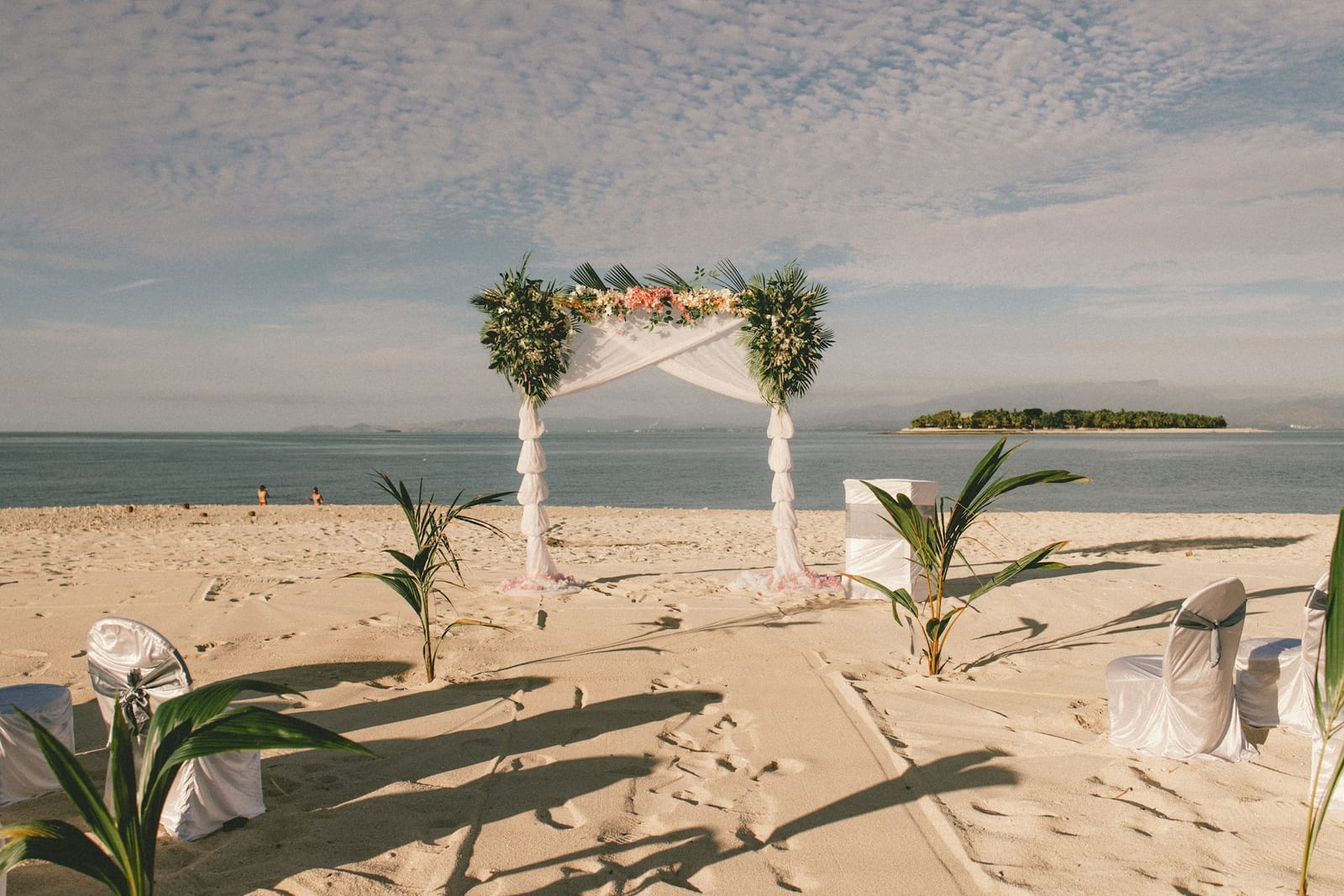
The settings are what justify the airfare. The barefoot sandbank ceremony — vows on a bare strip of sand with nothing but lagoon in every direction — is the defining Maldives image, with the beach-at-sunset version close behind. Then there's the genuinely unusual option: vows held inside an undersea restaurant. Conrad Maldives Rangali Island stages ceremonies at Ithaa, the world's first all-glass undersea restaurant, opened in 2005 and sitting five metres below the surface — its name means "mother of pearl" in Dhivehi. Hurawalhi, an adults-only resort in the northern Lhaviyani Atoll, offers vows at its 5.8 Undersea Restaurant, billed as the world's largest all-glass undersea restaurant, 5.8 metres down, alongside its sandbank and sunset Champagne Pavilion options. One honest note: "underwater" here means a glass-walled fine-dining room beneath the lagoon, not scuba gear and regulators — unless a resort specifically arranges a dive ceremony. The restaurants hold the verified records; the marketing that calls them the world's first underwater wedding venues does not, so take that part with salt.
Vow renewals, guests, and when to go
If you're already legally married, the smartest version of this whole exercise is the vow renewal — and frankly it's the one that suits a Maldives audience best. There's no legal status to fudge, no certificate to over-explain, no awkward gap between the registry and the romance. You get the identical sandbank, the same celebrant and the same photographer, with zero friction. For couples who've done the paperwork years ago, or who quietly signed it at home last month, the renewal is simply the cleaner product wearing the same dress. Bringing guests scales the cost and the coordination; eloping keeps both small — neither is more "real" than the other, since the legal reality is the same in both cases.
The calendar is the one your honeymoon runs on too. The dry north-east monsoon, roughly November to April, gives the most reliable conditions, with December to March the peak and February and March the driest, least humid months of all. The wet south-west monsoon from May to October brings brief afternoon showers, lower rates and thinner crowds — the value season — with late June into early August the wettest stretch. The catch is the obvious one: peak weather and peak prices arrive together, so the most photogenic window is also the most expensive.
And because the ceremony and the honeymoon are almost always the same trip, the harder decision isn't the vows — it's the island you say them on. Our Maldives honeymoon guide covers how to choose the right one: atoll, villa type, transfer, and the trade-offs that decide where your first married morning actually happens.