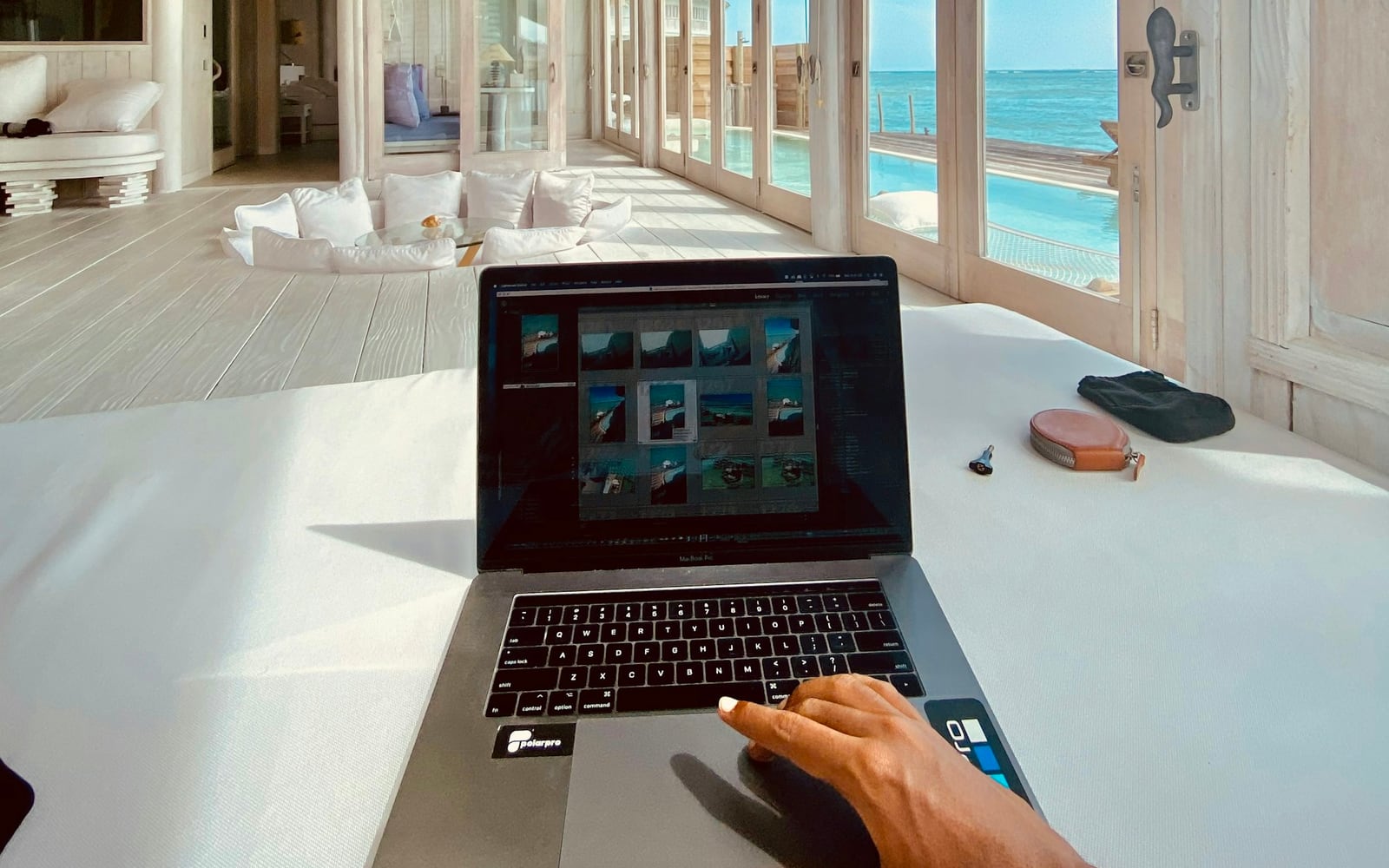
Walk up to the Dhiraagu counter at Velana airport, buy a tourist SIM, and there's a fair chance you'll never use it. The eSIM guides that fill the search results have a structural reason not to tell you that: most exist to sell you an eSIM, so the one line they bury is the one that matters most — a guest flying into a single resort and out again often needs no mobile data at all. The villa wifi is free, it covers messaging, calls and a Netflix binge, and the rest of the trip happens inside that bubble. So before you compare plans, the honest first question isn't which SIM — it's whether you need to buy anything.
That answer turns almost entirely on one thing: whether you ever leave the resort. If your itinerary is a seaplane in, a week on the island, and a seaplane out, the case for buying data is thin. Where it flips is the local-island and guesthouse trip, a stopover in Malé, a ferry or domestic-flight day with bags to track and maps to follow, or the simple comfort of having Google Maps and WhatsApp live the moment you clear immigration rather than after you've found the right counter. Those are the travellers who genuinely benefit. Everyone else is mostly buying peace of mind — which is a real thing to buy, just be honest with yourself that that's what it is.
Do you even need mobile data in the Maldives?
Start with what the resort already gives you. Free wifi is now the norm rather than a premium add-on — even at the very top end, properties that once metered it now bundle it into the room, and the old paid-tier model has largely faded. What hasn't been solved is quality, and that's the warning worth heeding instead. Coverage tends to be strong around the hub — reception, the restaurants, the bar — and weaker out at the far overwater villas, the very ones people pay most to stay in. A booking page that promises 'free wifi' is promising the connection exists, not that it'll stream cleanly from a water villa at the end of the jetty. If that matters to you, ask the resort directly or read recent reviews; signal strength is genuinely property-specific.
The baseline keeps improving, though, and for honest reasons. Maldives internet penetration was roughly 84% of the population in 2024, the country is wired together by submarine and inter-island fibre — the SEA-ME-WE 6 cable landed in 2024 — and Starlink has been licensed since 2023 to serve even remote islands and vessels. You don't buy any of that as a tourist; it shows up as a better connection in your villa, which is rather the point. The plumbing behind resort wifi is real infrastructure, not a single straining satellite dish.
Local SIM at Velana: Dhiraagu vs Ooredoo
If you do want data, the landscape is simple: two networks, full stop. Dhiraagu and Ooredoo are the country's only mobile operators, and both sell prepaid tourist SIMs — physical and eSIM — from counters in the arrivals area at Velana, open long hours including for arriving flights. Bring your passport: registering a SIM to a verified ID is a legal requirement here, so there's no anonymous pay-and-go option. A tourist plan runs very roughly USD 35–50 for tens of gigabytes over a few weeks, usually with some local minutes and SMS folded in, and higher tiers climbing toward USD 100 for far more data. Treat every one of those figures as approximate — telecom plans churn constantly, and the honest move is to read the board at the counter rather than trust a price someone wrote down last year.
Ignore the older guides that tell you 5G is barely a thing here. Dhiraagu launched the first commercial 5G in South Asia back in 2019, Ooredoo followed soon after, and by 2025 Ooredoo reported its 5G reaching around 80% of the country. Real-world speeds back this up — median mobile downloads sit around 70 Mbps, with 5G users seeing far higher. The fair caveat is geography, not technology: that coverage is concentrated around Malé and the built-up, tourist-heavy zones, and thins out across the remote outer atolls, where you may drop to 4G or lose signal entirely on the water between islands.
Before you compare plans, ask the honest question: at a resort, the free villa wifi is usually enough, and the cheapest right answer is often to buy nothing.
eSIMs: when they're worth the premium
Travel eSIMs — Airalo, Holafly, Saily, Nomad and the rest — solve one specific problem well: you buy and activate before you fly, so you land already connected and skip the counter queue entirely. They ride on the same two local networks, because there are only two, so you're not getting different coverage, just a different way of buying it. Airalo's single-country Maldives plan, for instance, runs around 20 GB for 30 days at roughly USD 40 data-only, or about USD 45 with a local +960 number and calls — most data-only eSIMs don't give you a callable number, which matters if a resort or transfer desk needs to phone you. Holafly markets an 'unlimited' option, but read that as fair-use unlimited: heavy streaming can be throttled, so it's not a truly uncapped pipe.
Two honest caveats keep the eSIM in proportion. First, the convenience usually costs a little more than a SIM bought at the counter — you're paying for the pre-arrival activation, which is a fair trade only if landing connected genuinely matters to you. Second, ignore any guide that confidently states 'brand X runs on Ooredoo' or 'brand Y runs on Dhiraagu' — reputable sources directly contradict each other on this, providers swap underlying carriers over time, and some don't disclose it at all. Don't pick an eSIM on a network claim; pick it on price, data allowance and whether you need a number. And check you have an eSIM-compatible, unlocked handset before you buy anything, because a QR code is useless to a phone that can't take it.
The decision, by traveller type
It comes down to where you'll actually be. The resort-only honeymooner needs nothing — the villa wifi does the job, and a SIM bought 'just in case' is usually wasted money. The local-island, guesthouse or Malé-stopover traveller is the one who genuinely wants connectivity off the resort, and either a counter SIM or an eSIM serves equally; choose on price and patience. The arrival-and-transit type — anyone who wants Maps and messaging live the second they land, before finding a counter — is the textbook case for a pre-loaded eSIM. And the heavy streamer or remote worker should reach for the highest-gigabyte local SIM, the cheapest route to a lot of data, with the standing reminder that 5G is concentrated in the tourist zones and thinner out in the far atolls. Whatever you land on, don't over-buy: a 125 GB plan is a strange purchase for someone who'll spend the week behind free wifi.
Sorting your connectivity is the small last piece of a much bigger arrival puzzle — seaplanes, speedboats, domestic hops and the timing that ties them together. Our guide to how to get to the Maldives walks through the transfers themselves, so you know exactly where a live phone earns its keep and where the villa wifi has you covered.