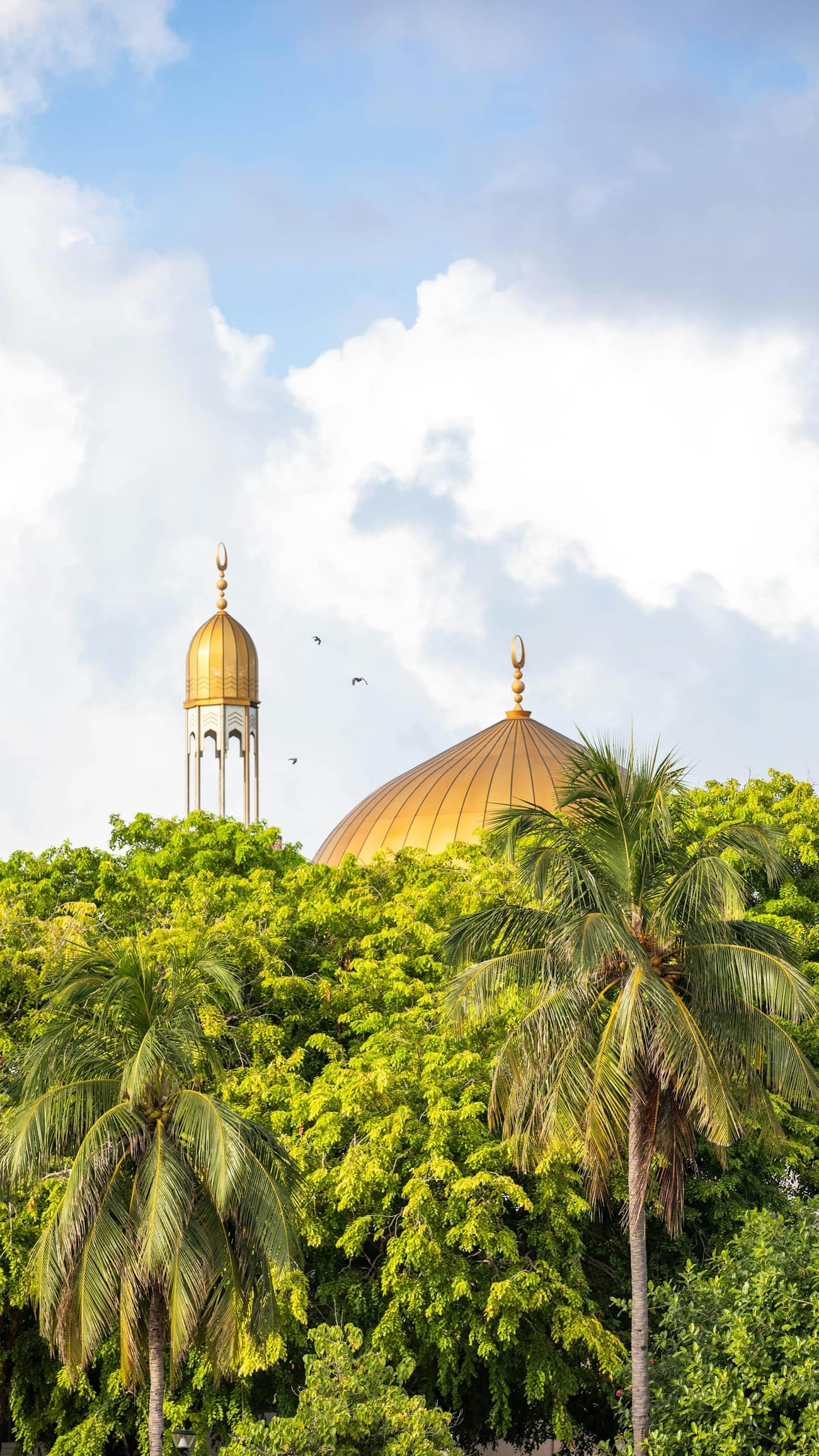
Most visitors experience the Maldives as a string of private resort islands where the cocktails flow and the only dress code is sunscreen. So it surprises people to learn that they are holidaying in one of the most religiously uniform nations on Earth — a country whose constitution names Sunni Islam as the state religion and the foundation of its law, and which, uniquely among the world's countries, bars anyone who is not Muslim from holding citizenship. By legal definition, the Maldivian citizenry is 100% Sunni Muslim. The president, ministers, judges and members of parliament must all be Sunni.
It wasn't always so. For more than a millennium the islands were Buddhist, from around the third century BCE until 1153 CE, when — as tradition recorded by the traveller Ibn Battuta has it — a visiting North African scholar banished a sea-demon that locals had been appeasing with human sacrifice, and persuaded the last Buddhist king to convert. The king took the name Sultan Muhammad al-Adil, and an Islamic sultanate began that would last nearly eight centuries.
The two worlds
For travellers, the thing to understand is that the Maldives runs on two parallel realities, and they coexist entirely by design. On a private resort or liveaboard island, alcohol is served, pork is on the menu and bikinis are fine — because resorts hold special tourism licences that exempt them. Step onto an inhabited "local" island and the rules invert completely: no alcohol or pork at all, modest dress covering shoulders and knees in public, and swimwear only on government-designated "bikini beaches" set aside for tourists. This split is not a quirk; it's the deliberate legal architecture that has let a devout country run a liberal tourism industry without one swallowing the other.
Alcohol on resorts isn't a loophole — it's a licence. The same one is why pork is on the buffet there and nowhere else.
What it means in practice
On a resort, religion barely touches your holiday. The adjustments come the moment you leave the bubble — on a guesthouse stay, a local-island day trip, or a few hours in the capital. Pack a sarong or light layers, leave your alcohol behind (you can't carry it off a resort, and you can't bring any into the country at all — it's confiscated at the airport on arrival and returned when you leave), and expect halal-only food. The alcohol rule is not bureaucratic theatre: drink carried off a resort or onto a local island is seized, and tourists have been arrested, detained and deported for it. The same arrival screening applies to non-Islamic religious texts and idols or figurines for worship, which can be questioned or confiscated — if a copy of your scripture matters to you, bring it on a phone or Kindle rather than in print. During Ramadan, local-island cafés close in daylight hours and reopen after the sunset Iftar, though resorts run exactly as normal. You'll hear the call to prayer five times a day, and on Fridays shops pause for the main congregational prayer.
Being a good guest
The honest framing isn't a list of gotchas — it's that you're a visitor in a conservative Muslim community, and a little consideration goes a long way. It's worth knowing the legal facts plainly: propagating non-Islamic faiths is prohibited, there are no public churches or temples, and same-sex relations are illegal under Maldivian law (rarely an issue for tourists in practice, and resorts welcome all couples). On an inhabited island, ask before you photograph people — particularly women — rather than shooting candidly. The guesthouse-tourism boom of the last fifteen years is what brought visitors into contact with local islands at all — which is exactly why this etiquette, once irrelevant to a resort-only holiday, now matters. Respect it, and the welcome you get on a local island is one of the warmest in the region.
Deciding between a resort cocoon and a local-island stay? Our Maldives trip-planning guide covers the trade-offs, the costs and how to combine the two worlds in one trip.