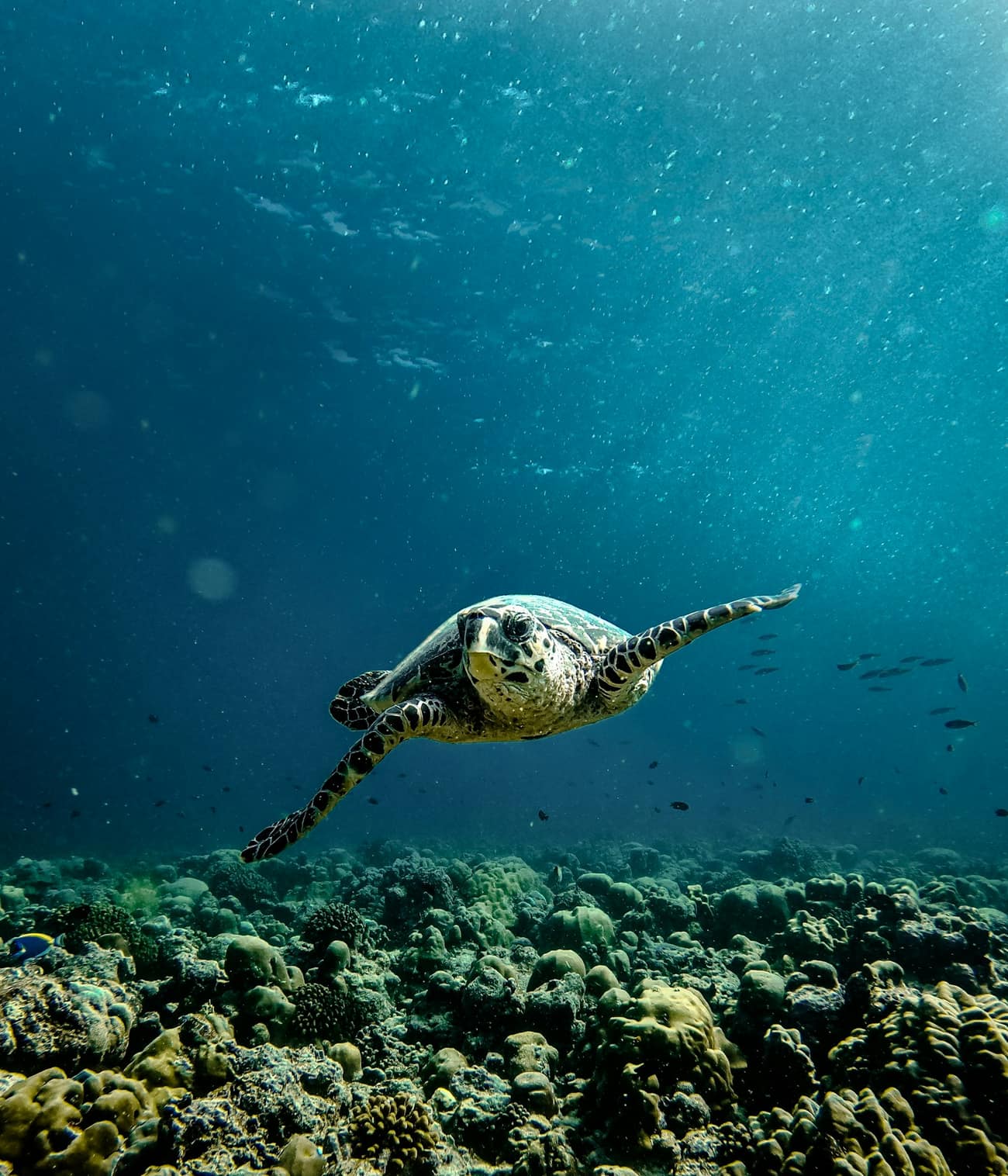
Most sea turtles a visitor meets in the Maldives are locals — green turtles and hawksbills grazing the house reef, animals that live here and nest on these beaches. The olive ridley is different. When one turns up in the Maldives it has almost always arrived the hard way: drifting in on the current with its flippers bound in a tangle of fishing net, dehydrated, exhausted, and frequently missing a limb. In Maldivian waters the olive ridley is not a resident. It is a patient.
That distinction is the whole story, and it is the one most travel writing gets wrong by lumping all the turtles together. Five of the world's seven sea-turtle species pass through the Maldives, but only two — the green and the hawksbill — nest here with any regularity. The olive ridley is an ocean wanderer that nests in vast synchronised arrivals on a handful of beaches in India, Mexico and Central America, and essentially never in the Maldives. It is the smallest of the sea turtles and the most numerous worldwide, yet the IUCN still lists it as Vulnerable and its numbers are falling. What brings it to these reefs is not biology but rubbish.
Death by ghost gear
The culprit is "ghost gear" — fishing nets that have been lost, abandoned or discarded and now drift the Indian Ocean for years, catching everything they touch. Olive ridleys are hit far harder than other turtles, and the reason is in their habits: they live out in the open sea, bask at the surface, and are curious about floating debris — exactly the behaviour that turns a drifting net into a trap. One peer-reviewed study put the odds starkly: olive ridleys were roughly nineteen times more likely to be found entangled than any other sea turtle. A net wrapped tight around a flipper cuts off the blood supply; by the time the turtle washes up, the limb is often beyond saving.
In Maldivian waters the olive ridley is not a resident. It is a patient — and the injury is almost always a net.
There is a bitter geography to it, too. The Maldives barely uses nets — its tuna fishery is the one-by-one pole-and-line kind — so the gear maiming its turtles drifts in from industrial fisheries elsewhere in the Indian Ocean, carried on the same north-east monsoon currents that shape the dive season. The country is downstream of a problem it did little to create, and the rescue season (roughly November to March) is simply the weather window in which those currents deliver the most casualties.
A charity that began with the nets
The response grew out of one biologist's frustration. Working in the Maldives around 2013, Dr Martin Stelfox kept finding olive ridleys strangled in ghost nets and began logging the cases; that record became the Olive Ridley Project, a UK-registered charity that started by tackling the gear itself — it has since pulled more than fifteen tonnes of derelict net out of the Indian Ocean — and then had to build somewhere to treat the casualties it kept finding.
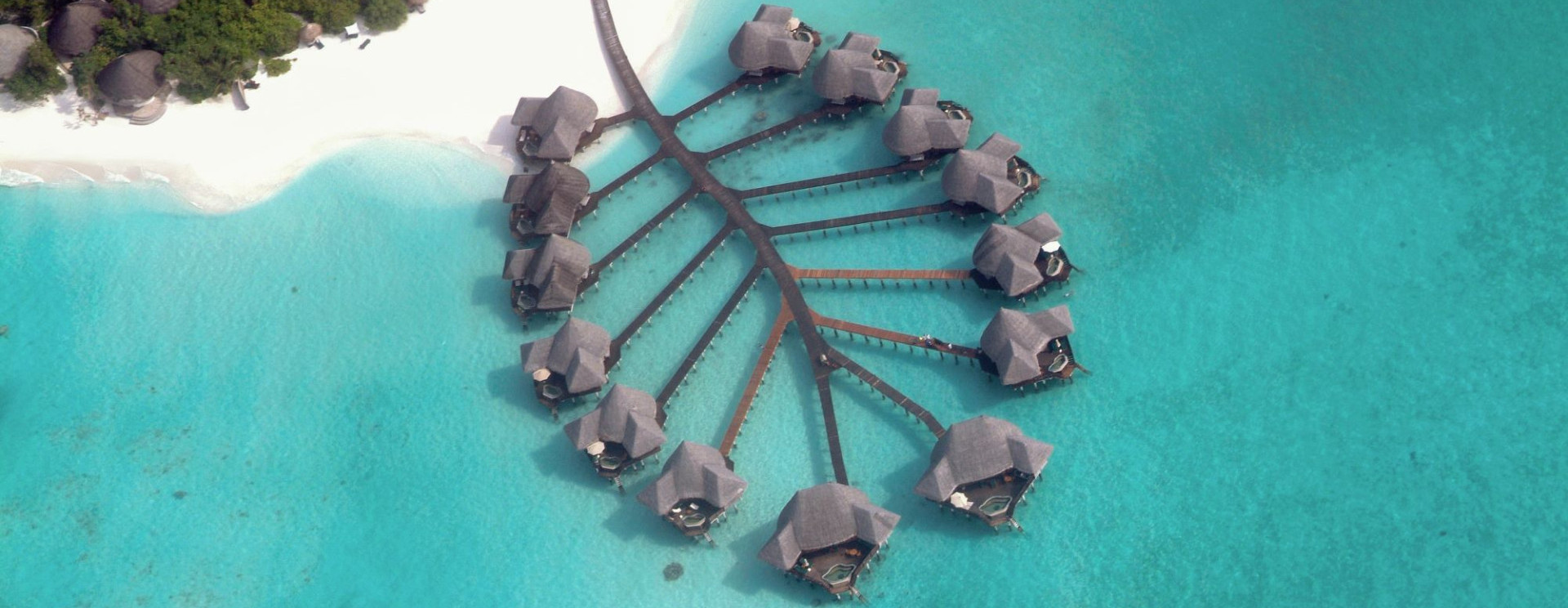
In February 2017, in partnership with the resort Coco Palm Dhuni Kolhu in Baa Atoll, the project opened the Maldives' first fully equipped, vet-led sea-turtle rescue centre. It is a working clinic, not an attraction: tanks of recovering turtles, ICU pools for the critical cases, surgery for the entanglements that can't be saved any other way. Many patients leave as permanent amputees — one olive ridley named Heidi, missing a front flipper, was rehomed to an aquarium in England when release proved impossible. But the amputees are not the whole ledger: most patients do recover, and the project has rehabilitated and returned more than a hundred and forty turtles to the wild — a release rate of roughly 60 per cent. Olive ridleys make up something like four in five of the admissions. The Baa clinic remains the network's rescue and intensive-care end; it has since grown to centres in Lhaviyani and Raa (the latter at JOALI BEING), and in 2024 the project opened its largest facility yet, a Noonu Atoll step-down centre run with Soneva for patients no longer in critical care but not yet ready for release.
What a traveller can actually do
Guests at Coco Palm Dhuni Kolhu can visit the rescue centre and watch the patients being fed, but the framing matters: this is conservation medicine, not a petting pool, and not every turtle gets a happy ending. The more useful contribution is quieter. Every sea turtle carries a unique pattern of scales on the side of its face — a fingerprint that never changes — so a clear photograph of a turtle's cheek, sent to the project's database, becomes a genuine data point in tracking the country's resident greens and hawksbills. And if you ever find a turtle wrapped in net, the advice is the same everywhere: photograph it, note the spot, and call a marine biologist rather than cut it free yourself. The olive ridley got into this trouble because of human carelessness with gear; getting it out is a job for people who know what they are doing.
Baa Atoll is where this work is centred — and where the manta season runs. Our Baa Atoll guide covers the resorts, the marine programmes and the reserve's conservation rules.