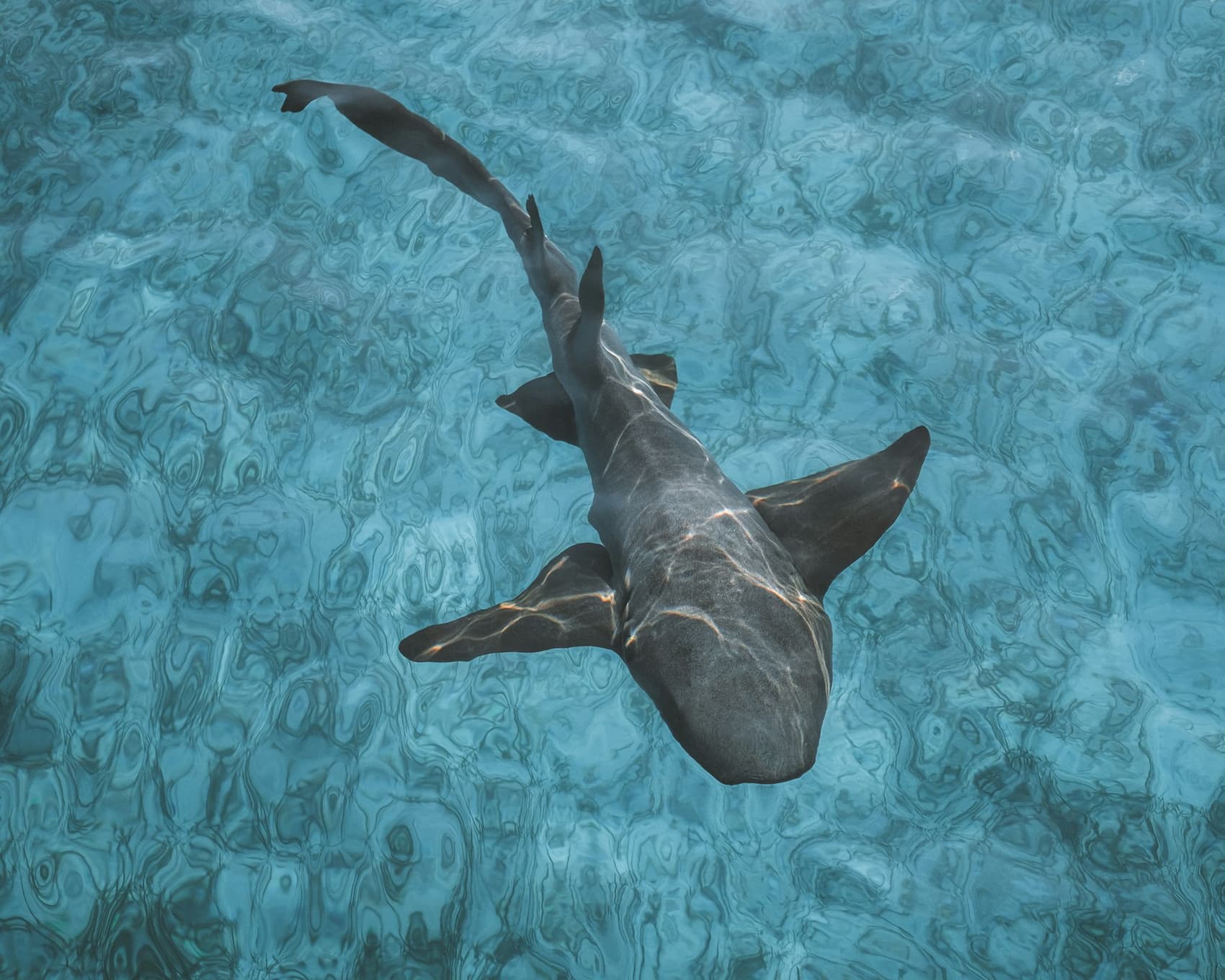
Drop into the water off the Alimatha jetty after dark and you are surrounded within seconds. Tawny nurse sharks — slow, blunt-headed, two and three metres long — slide past your shoulders in their dozens, jostling with stingrays the size of café tables and giant trevally that flash silver through the torch beams. Few night dives anywhere on Earth deliver this much large animal at arm's length. It is genuinely thrilling, and it is genuinely complicated, and the honest version of the story holds both at once.
Meet the tawny nurse shark
First, the animal — because most write-ups get it wrong. These are tawny nurse sharks (Nebrius ferrugineus), an Indo-Pacific carpet shark, not the Atlantic nurse shark whose name they borrow. They are built for a nocturnal, bottom-feeding life: by day they doze in heaps under ledges, and by night they hoover the reef, pressing a small mouth against a crevice and using a muscular throat as a suction pump to inhale octopus, crustaceans and urchins. They are slow, docile and, under normal circumstances, harmless to a diver — the handful of recorded bites all trace to someone grabbing, riding or hand-feeding one. They also reach well over three metres and have serious jaws. Docile is not the same as tame.
Why the sharks are there
Here is the part the brochures skip: the spectacle is, in large part, manufactured. The Alimatha aggregation grew out of the resort's kitchen routine — staff cleaned the day's fish on the jetty and threw the scraps into the sea — and over years the sharks, rays and trevally learned to gather there every night for an easy meal, with dive guides sometimes adding bait to thicken the show. What you are watching is real nurse-shark behaviour, but its density and its boldness are a learned response to decades of feeding.
What you are watching is real behaviour — but its density and boldness are a conditioned response to decades of feeding.
That matters because feeding sharks is, in fact, against the rules here. The Maldives declared its entire waters a shark sanctuary in 2010, banning shark fishing outright, and in 2021 the tourism ministry reaffirmed that feeding sharks is illegal under the recreational-diving regulations, citing both rising bite incidents and the disruption to natural behaviour. Enforcement, though, is patchy: rather than stop, many operators simply moved the feeding off the jetty and onto boats or quieter spots, so the encounter persists in altered form while its legality stays openly contested.
The genuine dilemma
The conservation argument is not as one-sided as either camp pretends. Provisioning does condition animals, can make them pushy, and may raise the risk of bites in a competitive feeding scrum — and conditioning a slow-breeding, IUCN-listed Vulnerable species is a sharper concern than "feeding is bad" in the abstract. One popular operator defence — that feeding only protects pregnant females from aggressive males — doesn't survive scrutiny, since no dive centre can choose which sharks turn up and the feeding runs year-round. And yet shark tourism is worth hundreds of millions of dollars a year worldwide, which gives living sharks an economic value that has demonstrably shifted public attitudes away from fear. A diver who has hung motionless among fifty nurse sharks rarely fears them again.
Beyond the jetty
What the Alimatha circus tends to overshadow is that Vaavu is one of the Maldives' great channel-diving atolls — and those dives need no bait at all. Vaavu (Felidhu) is among the least-developed atolls in the country, barely five inhabited islands, and its reputation rests on the tidal channels, or kandus, that funnel current — and pelagic life — between reef and ocean. Fotteyo Kandu is regularly called the finest channel dive in the Maldives, a wall of overhangs and swim-throughs draped in soft coral — open to the blue throughout, nothing enclosed; Miyaru Kandu translates literally as "shark channel," named for the grey reef sharks that stack up on the incoming tide. These are advanced drift dives in two or three knots of current — they ask for an advanced ticket and dozens of logged dives where the night dive asks for none — and they are best run from January to April, when the north-east monsoon flattens the sea and lifts visibility past thirty metres. Wild in the genuine sense, and the better argument for coming to Vaavu at all.
The 2026 cave diving accident
Two very different dives happen in this water, and since May 2026 they have been badly conflated. On the fourteenth of that month, five Italian divers died inside a cave system off Alimatha, in the worst diving accident ever recorded in the Maldives; a Maldivian coast guard sergeant major, Mohamed Mahudhee, was killed during the recovery that followed. The dive that killed them is not the dive described above. Theirs was a technical penetration of a multi-chamber cave at around fifty metres — roughly twenty metres past the Maldives' recreational limit, in an overhead environment where a silt-out leaves no straight route to the surface. The investigation found they had exhausted their air. The night dive at the jetty is a different activity in the same stretch of sea: shallow, open water above you the whole way, gentle enough that snorkellers do it.
What came afterwards is the part worth carrying into a booking. The tourism ministry suspended the operating licence of the liveaboard involved and a culpable-homicide investigation was opened; officials said they had not been told the group intended to enter a cave at all. Rather than ban the practice, the government moved to license it — a technical and wreck diving framework, drafted with the industry, that will put cave, deep-wreck and other overhead diving behind permits issued to suitably certified divers and researchers. Until that exists, the position is the one that always applied, and it is worth stating plainly: recreational diving in the Maldives stops at thirty metres, no recreational certification covers an overhead environment, and the enthusiasm of whoever is leading the dive is not a qualification. Ask exactly what a dive involves before the boat leaves, and be willing to sit one out.
Getting there is the easy part. Alimatha sits a short hop south of Male — roughly twenty minutes by seaplane, or about ninety by speedboat (the only option after dark, since seaplanes fly daylight hours only). The night dive itself runs three ways: from the resorts on Alimatha and neighbouring Dhiggiri, from the liveaboards that work the atoll, and as a budget day-trip out of the local island of Maafushi. And unlike the channels, it asks nothing of you — shallow, calm water a snorkeller or first-time diver can slip into, which is the whole point: you do not have to be a diver at all to hang among the sharks.
Vaavu rewards divers who want big water without the crowds. Our Vaavu Atoll guide covers the channel dives, the night dive and the handful of resorts and liveaboards that work the atoll.